
Shifting Paradigms: The Case for Tethered Cargo Airships in Modern Logistics
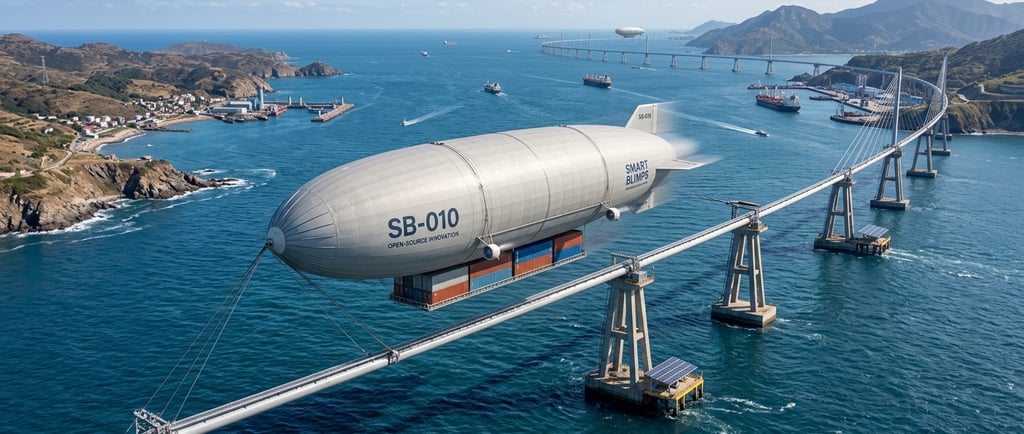
Unlike traditional airships that fly completely free, a tethered cargo airship system operates as a guided transport network. The vehicle is permanently coupled to a high-tensile guide cable anchored across a strategic strait or transit corridor.
Admin
5/15/20263 min read
Shifting Paradigms: The Case for Tethered Cargo Airships in Modern Logistics
The global logistics network is facing a structural bottleneck. As international trade scales, the traditional answers to connecting isolated regions, islands, or narrow straits remain stubbornly tied to 19th-century heavy engineering: multi-billion-dollar bridges or subsea tunnels.
These massive infrastructure projects carry astronomical financial risks, take decades to build, and leave deep scars on local ecosystems.
But what if we didn’t need to fight gravity or excavate the seabed to build a bridge? What if we could build a bridge made of air, data, and tension?
Enter the concept of Tethered Cargo Airships—a hybrid approach to logistics that bridges the gap between aerostatics, automated rail systems, and open-source innovation.
The Concept: The "Atmospheric Railway"
Unlike traditional airships that fly completely free, a tethered cargo airship system operates as a guided transport network. The vehicle is permanently coupled to a high-tensile guide cable anchored across a strategic strait or transit corridor.
This subtle shift in design fundamentally changes the physics—and the economics—of cargo transport:
Infrastructure Without Weight: In a traditional bridge, 80% of the structural engineering exists simply to hold up the weight of the bridge itself and the vehicles on it. With an airship system, the lifting gas (helium or non-flammable nested hydrogen cells) provides 100% of the buoyancy. The ground infrastructure doesn't support weight; it only guides direction and handles tension.
Externalized Power: Because the airship follows a fixed cable, it doesn't need to carry massive, heavy batteries or fuel tanks. Clean electrical power can be supplied directly through the tether system, creating a 100% electric, zero-emission cargo conveyor belt.
Continuous Multi-Modal Flow: Instead of waiting for massive container ships or ferries to fill up, cargo can move continuously. Standardized freight containers (TEUs) are attached to individual airships, creating a virtual, non-stop "train in the sky" moving at speeds of up to 150 km/h.
Why Strategic Straits and Islands are the Perfect Sandbox
The true sweet spot for this technology lies in short-to-medium-range bottlenecks, such as archipelagos or narrow maritime channels like the Strait of Gibraltar.
A subsea tunnel across a 14-kilometer strait can easily exceed €10 billion and take 15 years to construct due to complex underwater geology and seismic risks. Conversely, a tethered airship system requires only deep-sea anchoring buoys and terminal stations. It bypasses geological hurdles entirely.
Conquering the Wind
The immediate critique of any airship concept is weather—specifically, high winds. However, a tethered system turns a vulnerability into an asset. By utilizing a dynamic tension matrix, the airship acts similarly to a kite or an airplane wing. Advanced flight-control AI adjusts automated aerodynamic fins in real-time, utilizing crosswinds to actually stabilize the craft against its guide rail rather than being blown off course.
From Macro-Vision to Micro-Validation: The Open-Source Roadmap
An infrastructure shift of this scale doesn't happen overnight in private silos. Following a philosophy of collective progress and open-source innovation, the roadmap to validating this technology starts from the ground up.
Before deploying kilometric vessels across international waters, the core mechanical principles can be proven using Rapid Prototyping and Fab Labs.
By constructing scaled, 3-to-5-meter functional MVPs (Minimum Viable Products), engineers can test neutral buoyancy, automated pulley triction, and algorithmic wind resistance using simple microcontrollers (like Arduino or ESP32) in controlled environments.
Once validated at a micro-scale, the capital requirements to scale up remain a fraction of traditional civil engineering. For less than the cost of building a single kilometer of a subsea tunnel, an entire trans-strait tethered airship network could be fully deployed and operational.
A New Chapter for Global Trade
Tethered cargo airships represent a leap toward "light infrastructure." It challenges the assumption that moving heavy things requires heavy footprints. By combining the ancient wisdom of buoyancy with modern composite materials, automated grid power, and open-source collaboration, we can build logistics networks that are agile, vastly more affordable, and entirely harmonious with the planet.
The future of shipping isn't under the sea or stuck in port traffic. It's floating quietly right above us.
What are your thoughts on open-source, light-infrastructure logistics? Explore our vision and join the collaboration at smartblimps.com.
Contacts
tisnet2.0@gmail.com